How to Calculate Unity Gain Frequency
The frequency at which the output signal is reduced by 3 dB. View the full answer.

Important Op Amp Bandwidth Terminologies Circuit Smart Building Mathematical Analysis
Open loop gain for a system is more as compare to close loop.

. M T gsgd g ω CC Note as the capacitances get smaller the unity gain frequency gets larger. Draw an equal ground-centered sinewave delayed by 90120 - this is your output Vout. The unity-gain frequency ie.
Unity-gain frequency Transconductance Gate to source capacitanceCapacitance gate to drain ft gm CgsCgd This formula uses 3 Variables Variables Used Transconductance - Transconductance is the ratio of the change in current at the output terminal to the change in the voltage at the input terminal of an active device. The unity gain frequency is essentially the gain bandwidth product which is the frequency at which the amplifiers gain rolls off to unity. The unity gain frequency is a MOSFET device.
ωu of a transfer function is the frequency at which the magnitude of that transfer function equals to 1 or correspondingly 0dB. This is the op amp open-loop cutoff frequency. An op amp is able to amplify sound only through a certain range of frequencies.
When scientists calculate any theoretical gain G t of an op amp they also need to know the maximum theoretical frequency F t over which that gain will be available. I think you will find that closed loop gain is about -3dB at the unity gain frequency. A system gain without any feedback is called open loop gain.
1 In the case of ADA4004 the gain bandwidth product is 12 MHz. The -3dB frequency is the point where the output voltage 0707 OR 1root2 times the input voltage OR The -3dB power is half of unity power gain. Draw a ground-centered sinewave - this is your differential input voltage Vin - Vin-.
We review their content and use your feedback to keep the quality high. A system gain with feedback is called close loop gain. 2018-12-19 1131 am.
At high frequency you can neglect the 1 in the denominator. This is the op amp open-loop cutoff frequencyRelated searches for How to Calculate Unity Gain Frequencyunity gain frequency formulawhat is unity gainunity gain bandwidth formulaunity gain amplifierunity gain bandwidth op ampunity gain op ampunity gain bandwidthop amp unity gain frequencySome results have been removedPagination12345NextSee more. Is this true in ALL cases.
Usually at 1 MHz the gain tends to be unity otherwise known as 1. 1 In the case of ADA4004 the gain bandwidth product is 12 MHz. A system gain with feedback is called close loop gain.
Once it reaches its maximum frequency in which it was designed to handle it will then produce no gain at all after this. This means that at a gain of one the bandwidth is 12 MHz and at the maximum open-loop gain of 500000 the bandwidth is 12 MHz divided by 500000 which is 24 Hz. By normalising you mean call the maximum gain as 1.
Your circuit has an open-loop UGF and a closed-loop UGF. With our tool you need to enter the. Matlab code in the package NoiseBudget already is set up to calculate the unity gain frequency.
1 1 0. This means that at a gain of one the bandwidth is 12 MHz and at the maximum open-loop gain of 500000 the bandwidth is 12 MHz divided by 500000 which is 24 Hz. Ive been trying to find the formula via google and most sources have said.
Lets compute ωufor a voltage gain transfer function that has a single pole. The result is around 113Grps which is three times of the result. Mathematically the transfer function of interest can be expressed as follows.
The amplifier is tested in a unity-gain configuration with a small signal applied usually 200 mV p-p. View the full answerUnity-Gain Bandwidth BcL formula. A system gain without any feedback is called open loop gain.
Unity gain frequency Actually in this example it is given that Leff 035um W 500um Cox 38mFm2 Id 5mA I used mobility 00463m2Vs and saturation current formula to get gm and use Cgs 23CoxWL to get Cgs then use gmCgs to calculate unity gain frequency. Open loop gain for a system is more as compare to close loop. When scientists calculate any theoretical gain G t of an op amp they also need to know the maximum theoretical frequency F t over which that gain will be available.
BcL B Kn B Unity-Gain Frequency. BcL B Ao AoL Open-Loop Gain. The current getUGFm code reads in both IFO and noise parameters which are illustrated above by par and noise_par respectively.
Is this true in ALL cases. For any op-amp gain bandwidth product Unity Gain FrequencyMissing. Please support me on Patreon.
If it really has a first-order rolloff then they will be at the same point. Ive been trying to find the formula via google and most sources have said. Op-Amp Unity Gain FrequencyHelpful.
Kn Noise Gain. The last piece of information that the code needs to calculate the ugf is the current model of the DARM control loop. We can always calculate the bandwidth with the following formula.
Usually at 1 MHz the gain tends to be unity otherwise known as 1. Experts are tested by Chegg as specialists in their subject area. Kn Noise Gain.
For ANY case or design of an Op Amp the Unity-Gain Bandwidth BcL can be defined as. BcL B Ao AoL Open-Loop Gain. The blue graph shows the how the gain of an operational amplifier falls as we increase the frequency.
Frequency where the short-circuit current gain is equal to one. As for the e-book on the site I couldnt quite find this. The unity-gain bandwidth of an op amp is the entire range of frequencies in which an op amp can produce gain.
Determine the Required Unity Gain Frequency. BcL B Kn B Unity-Gain Frequency. Unity gain frequency is where the gain reaches unity or would reach unity when extrapolated from mid-band gain assuming first-order rolloff.
The Unity-gain bandwidth formula is defined as is the frequency at which the output signal is reduced by 3 dB is calculated using Unity-gain bandwidth Common-emitter current gain at low frequency 3-dB frequency. If you consider that the amplifier is a single pole system A1jwwp the gain will be equal to 1 at UGBAwp. The Unity gain frequency is the maximum value of gain that is Normalised to 1.
The minimum unity gain frequency for the op amp can be estimated by applying Equation 222. There is no direct spec given for Unity Gain Frequency or Unity Gain Bandwidth or Gain Bandwidth Product but it does provide a spec for rise-time 03 uS typical as well as slew rate at unity-gain 05 VuS typical. A low level signal is used to determine bandwith because this eliminates the effects of slew rate limit on the signal.
To calculate Unity-gain bandwidth you need Common-emitter current gain at low frequency β 0 3-dB frequency f L. We review their content and use your feedback to keep the quality high. 1 os T m iTTgs gd i ωω g i ωω ω CC Therefore we find that the unity-gain frequency of a MOSFET is.
For any op-amp gain bandwidth product Unity Gain Frequency. Experts are tested by Chegg as specialists in their subject area. Please see Tutorial MT-033 Voltage Feedback Op Amp Gain and Bandwid.
For the present case we have f U G b w R F R I R I f U G 25 k H z 24 k Ω 2 k Ω 2 k Ω 325 k H z. For ANY case or design of an Op Amp the Unity-Gain Bandwidth BcL can be defined as. Using this closed loop configuration we can find the cut-off frequency of the op-amp using this gain-bandwidth product.
Solved In These Queations How Was The Unity Gain Frequency Chegg Com

Pin On Ele216

Op Amp Common Mode Rejection Ratio Cmrr Of Operational Amplifier With Examples And Solutions Youtube Rejection Solutions Ratio
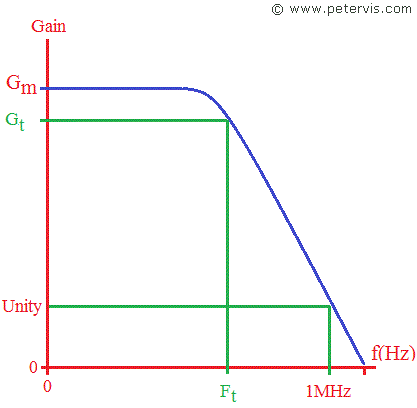
Theoretical Gain And Gain Bandwidth Product
No comments for "How to Calculate Unity Gain Frequency"
Post a Comment